


We’ve been doing a use case series where we look at the cost of installing different charging infrastructure.
So far we’ve looked at a carpet cleaning business that used 10 Level 2 chargers, and an AC business that used 10 DC fast chargers. We’re going to continue today with a use case that uses a mix of Level 2 and DC fast charging.
This is called opportunity charging. Opportunity charging is when you charge batteries during regular breaks rather than doing all the charging over night. This strategy can allow for longer vehicle up-time.
I’m going to be following the same general steps as the last two use cases. Today, I’m using a plumbing company also located in Iowa. The plumbing currently has 10 vehicles that they would like to move to electric vehicles.
First, we need to figure out what vehicle is best. It’s always important to start with the vehicle before figuring out what charger.
Vehicles
There are many vehicles to choose from, and many may work for your business. The most important things to look at are the daily route and how the vehicle is used.
Route
The plumbing business has a route that can vary depending on their customer. But generally they service customers within a 50 mile range. That means there’s 100 miles round trip. They have multiple customers in a day and so they sometimes will go over 100 miles between going back to their office and out to new customers.
Their business hours are 8 am – 5 pm They also run 24 hours a day. They also offer 24 hour emergency services. Which means that they may run vehicles at night as well when necessary.
They won’t go more than 120 miles round trip at one time before coming back to the office. They want to have 20% wiggle room on their battery so that they won’t risk running out of juice. That means they need a vehicle that has at least 144 mile ranger or higher.
Vehicle Needs
They want a vehicle that is easy to load and unload. Something compact that can be parked easily in front of customers houses. A vehicle that has multiple entry points is also a plus.
I can go to the CommercialEVs.com site and search for vehicles with a 144 mile range or higher and see which ones will work for my vehicle needs.
Vehicle Choice
For this plumbing business, the Ram ProMaster EV is the best choice. It has a 164 mile range, and multiple entry points. The ProMaster has rear doors as well as a sliding side door.

Next, we’ll pick what chargers to use.
Chargers
To figure out which charger is best, we need to know the dwell time of the vehicles.
Dwell Time
Typically, the plumbing business has vehicles that sit overnight. Occasionally, they have emergency after hours work and also have multiple customers during the day and they may need to go on a second or third route.
They need level 2 chargers for nightly charging and also DC fast chargers for opportunity charging. By utilizing one DC fast charger, fleets can charge multiple vehicles during regularly scheduled breaks. This allows fleets to have a safety net in case routes change or there is emergency after hours work.
Opportunity Charging Charger Choices
The 19kW Chargepoint CP6000 can charge the ProMaster from 20% to 100% in approximately 7 hours.
The 120 kW Chargepoint Express Plus can charge the ProMaster from 20% to 100% in approximately 1 hour. This charger can also be configured up to 375 kW which allows flexibility based on client needs.
Opportunity Charging Installation Costs
Now we can use the NREL EVI-Locate tool. Using this tool helps to give an estimate of how much it will cost to install infrastructure. First, define the site. A satellite view of an address can be used.
Now we’ll put in what type of chargers will be used. We’re going to use 5 – dual port 19 kW level 2 chargers and 1 – 120 kW DC fast charger. Next, you can select what types of chargers to use.
Then we’ll need to add where we want the chargers to go. There is a lot that goes in to choosing the right location for chargers, but since this is just an estimating tool, you can pick where ever you think you want them to go.
The location can always change and this modeling tool does not replace a design plan. That needs to be done by an engineering and design firm and will be required before any construction begins.
Next, it will ask if you need a 480v transformer and service panel. I said yes, this will most likely be needed, especially when installing DC fast chargers. And might be needed for level 2 chargers depending on how far away from existing electrical you are installing the chargers.
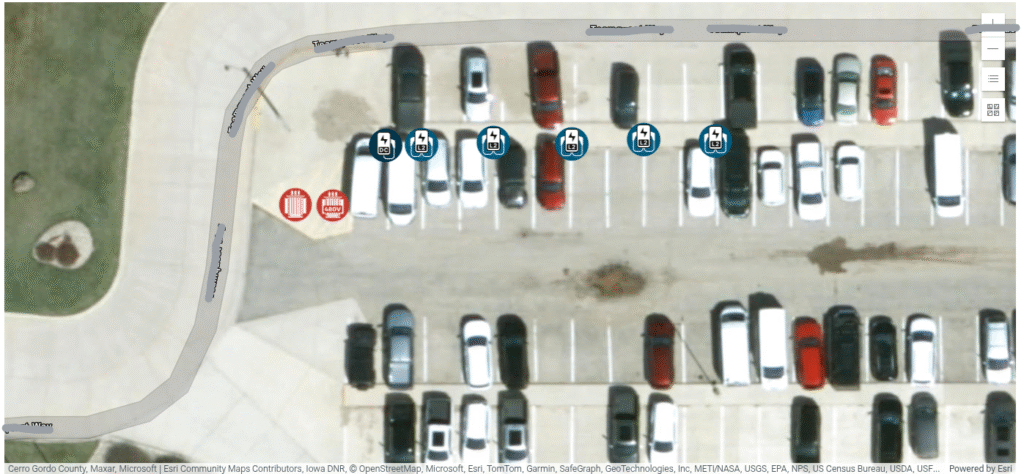
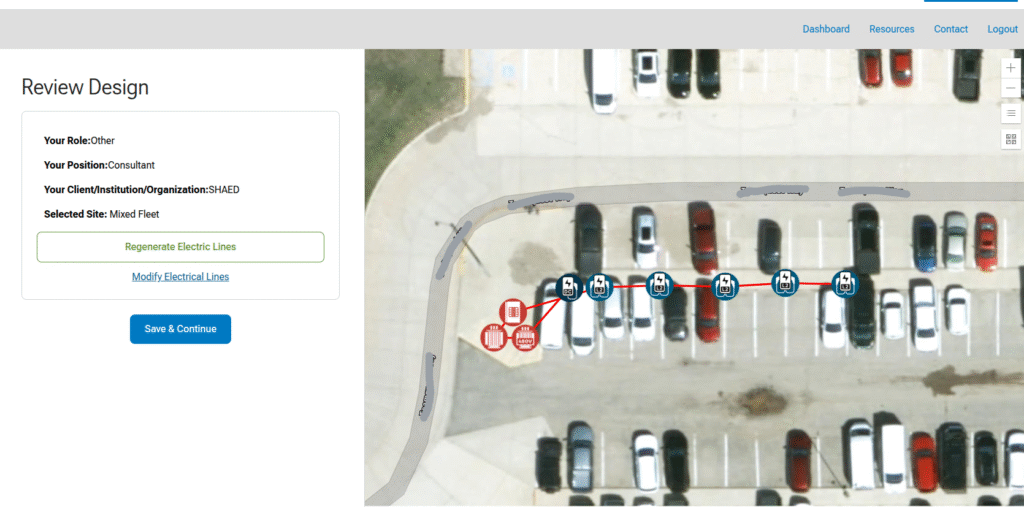
EVI-Locate doesn’t have the option, but you will need a 480/280 step down transformer. So this model shows a 480v transformer and a 208v transformer. We included both to ensure costs were covered.
Then the tool will show where the electric lines should go and estimate project costs.
Costs
You get multiple charts breaking down the cost of the whole project. This helps you to see all the different installation costs.
First, is the donut chart. This breaks down the different areas of the project – electrical, charging stations, constructions, and project costs.
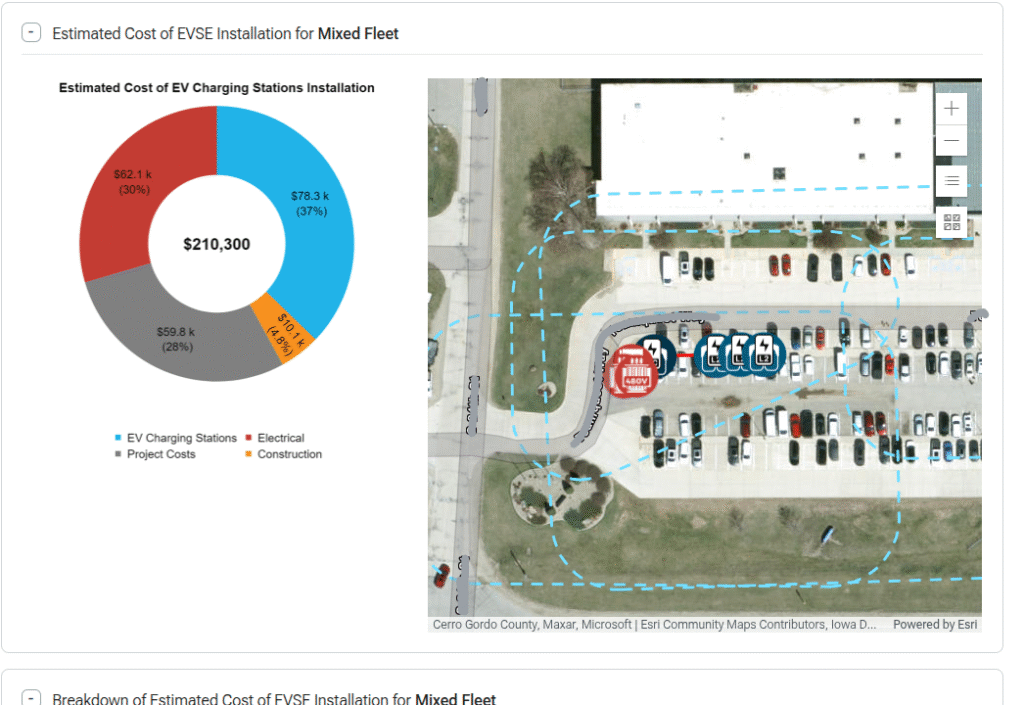
Then there is a bar chart. This breaks down the specific cost for every area of the project. There is also a bar chart that breaks down every cost of the project and includes a breakdown written out with number of each item.
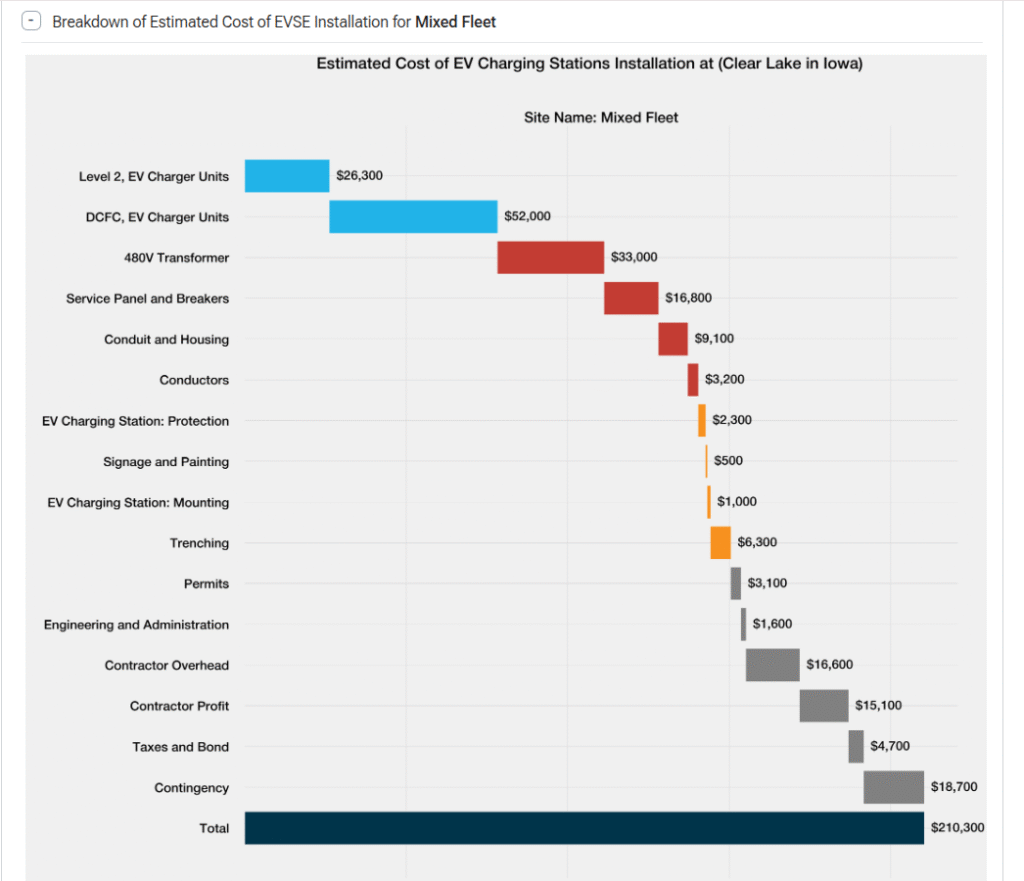
I feel this is a very comprehensive look at all the materials and labor that will go in to installing infrastructure.
Recap
The total estimated cost to install 10 level 2 chargers and 1 DC fast charger is $210,300. Of course, this is just an estimate, but it should give you a pretty good feel for everything that goes into the installation of chargers.
Anyone can use this tool to estimate how much it would cost to install infrastructure. We are always happy to help by answering any questions you may have as well.